
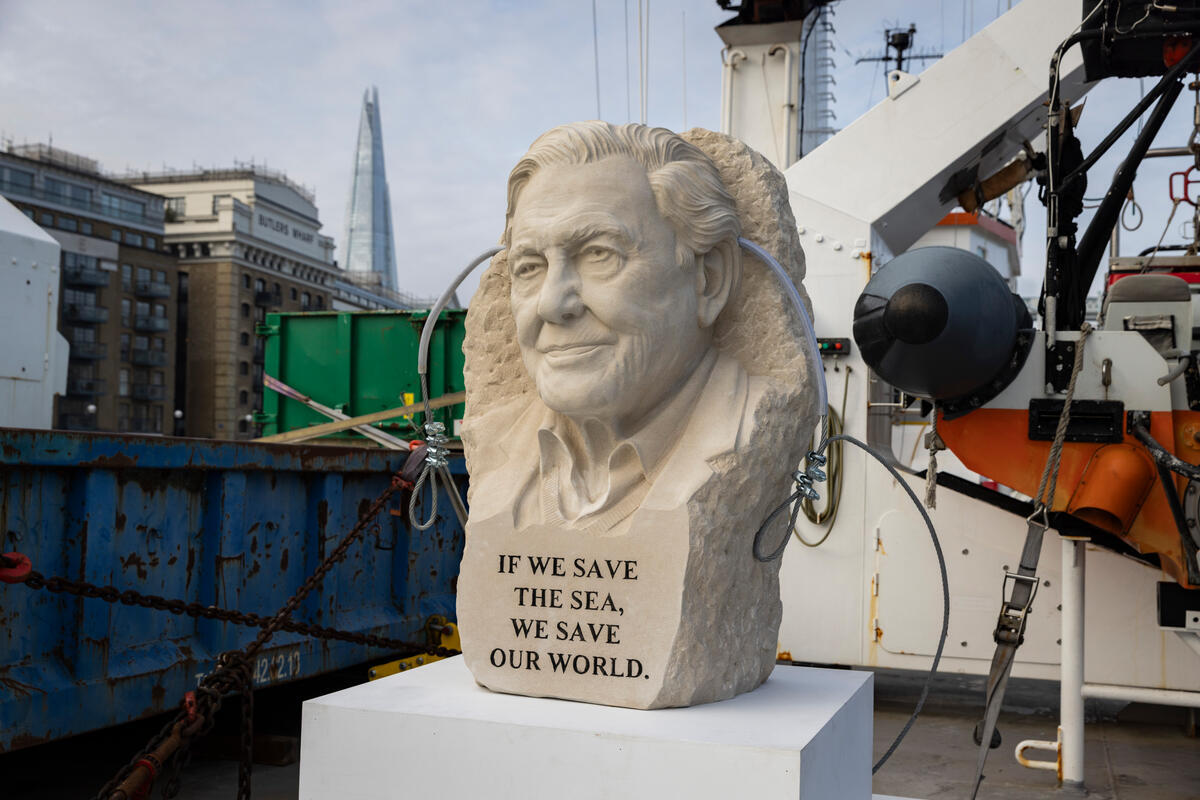
The 'Attenboulder' is a November 2026 stunt by Greenpeace UK: a giant limestone boulder carved to look like Sir David Attenborough, meant to be sunk in the North Sea to block bottom trawling. Greenpeace unveiled it on 10 November on its ship Arctic Sunrise on the River Thames, while millions of people were watching Blue Planet III.
Protest usually looks like signs and shouting. This one looks like a national treasure's face, carved in stone, about to go for a very long swim.
What is the Greenpeace Attenboulder?
It's a real boulder with a real job. Greenpeace has been dropping rocks on the seabed to stop trawlers dragging heavy nets across a protected area. The Attenboulder is meant to complete that barrier.
- The target area is the Southern North Sea, a sanctuary set up to protect harbour porpoises.
- According to Greenpeace, it's the UK's most heavily bottom-trawled marine protected area.
- Greenpeace has already placed nine boulders there and shared their coordinates with the authorities.
- The group says the barrier has effectively closed 116 square kilometres to bottom trawling.
- The Marine Management Organisation has warned Greenpeace it could face legal action if it adds more.
Why Attenborough?
Because nobody in Britain is more linked to the ocean on TV. Blue Planet III was on air, so his name was already in every living room. Greenpeace just asked the obvious question out loud: why can boats still scrape the seabed in a "protected" area while the whole country watches a show about protecting it?
Will McCallum, co-executive director of Greenpeace UK, said the government's inaction makes a mockery of the phrase "marine protected area" and insults Attenborough's work.
Why does it work?
- The pun carries the policy. "Attenboulder" is silly enough to share and still explains the whole tactic in one word: a boulder, for the oceans, in Attenborough's name.
- It's not symbolic. It's physical. Most stunts are a photo. This one is part of a barrier that already covers 116 square kilometres. The art piece has a day job.
- The timing is borrowed attention. Launching during Blue Planet III means the audience is already emotional about the sea. Greenpeace didn't buy that mood, it rode it.
- The legal threat makes the story bigger. A regulator warning of legal action turns a sculpture into a standoff. Standoffs get headlines.
Is this Greenpeace's usual playbook?
Pretty much, and it keeps working. In June 2026 Greenpeace renamed London Tube stations during a heatwave, turning Baker Street into "Baking Street". Same trick: take something everybody knows, twist it once, and the message rides on top.
Steal this
- Attach your cause to a moment people already care about. A TV premiere, a match, a heatwave. Don't create attention, redirect it.
- Make the stunt do real work. If your activation also solves part of the problem, nobody can call it "just PR".
- Use a pun if it explains the idea. Bad puns are noise. Good puns are a one-word brief.
- Name the tension. "Protected area" vs. trawlers inside it. Show the contradiction and let people get angry on their own.
FAQ
What is the Attenboulder?
It's a giant limestone boulder carved in the likeness of Sir David Attenborough by Greenpeace UK, intended to be placed on the seabed of the Southern North Sea to block bottom trawling.
Why is Greenpeace placing boulders in the North Sea?
Greenpeace says bottom trawling still happens in the Southern North Sea protected area. Its nine boulders so far have effectively closed 116 square kilometres to trawlers.
Is the Attenboulder legal?
The Marine Management Organisation has warned Greenpeace it could face legal action if it places more boulders.