
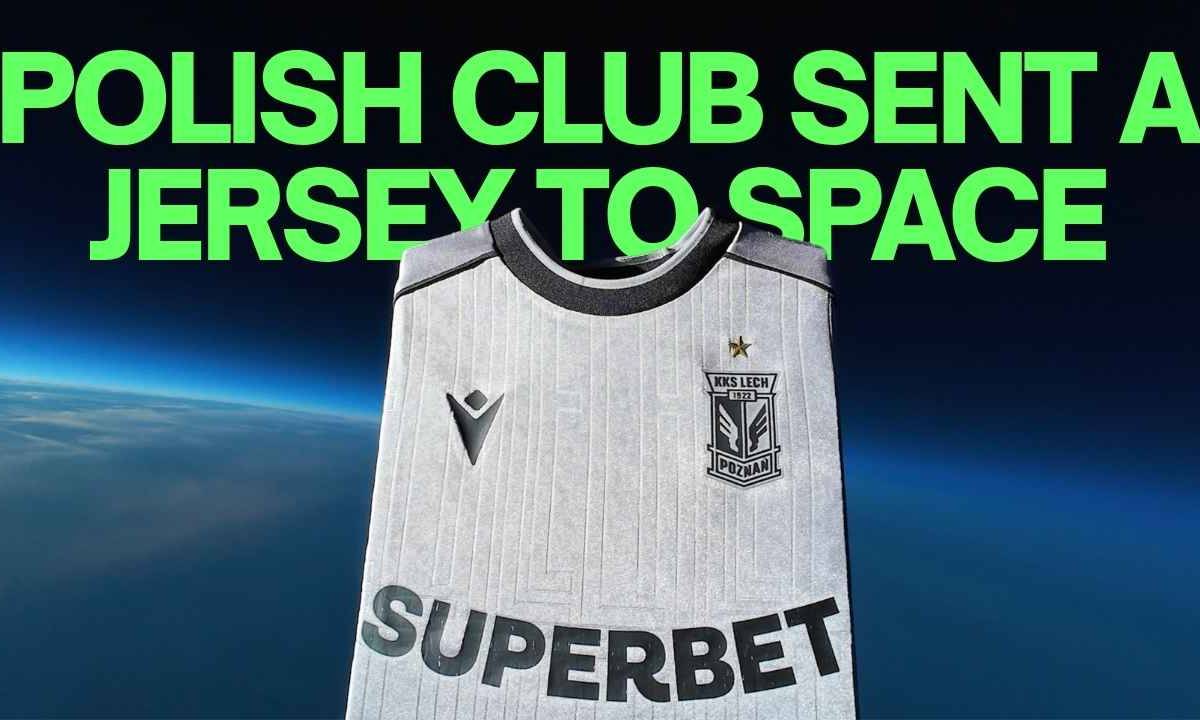
Guerrilla marketing has always been close to us at PEOPLE HATE ADS. Our founder, Kacper Bartoszak, wrote his master's thesis about it and has been looking for opportunities to apply the same thinking in real campaigns ever since. The idea is simple: instead of competing for attention by buying more advertising, create something people genuinely want to talk about. One of the best examples came from Kacper's work on the marketing team at Lech Poznań, where he came up with the idea of sending one of the club's match jerseys into the stratosphere and was responsible for the project on the club's side.
The idea of sending something into space had actually been around for a long time. But according to Kacper, it was only when he saw the jersey that everything clicked. "The idea of sending something into space had been in my head for a long time, but when I saw this particular jersey, I knew this was it. It was a perfect fit for the idea. For me, this project was the fulfilment of a marketing dream: doing something that the entire Polish football community would talk about, with the club I've supported since I was a kid, and writing a small part of the history of my favourite Polish football club."
The jersey was Lech Poznań's silver third kit, part of the club's "Third Dimension" concept, and the decision was made to send it into the stratosphere. The project would make Lech the first Polish football club to send a jersey to the edge of space, reaching an altitude of around 30 kilometres above the Earth.
The launch took place on September 9 during the Family Picnic with Kolejorz outside Enea Stadium in Poznań. The jersey was placed inside a specially prepared capsule, which was then attached to a stratospheric balloon. Lech player Pablo Rodríguez was responsible for launching the capsule, while the first part of the flight could be followed through the club's social media channels.
The technical side of the project required much more than simply attaching a jersey to a balloon. The capsule carried cameras that recorded the flight, while the balloon was designed to rise to around 30 kilometres before bursting. At that altitude, the capsule containing the jersey and cameras would begin its descent back to Earth under a parachute.
"We knew the jersey would rise to around 30 kilometres, where the balloon would burst and the package containing the jersey and cameras would return to Earth on a parachute. The conditions at that altitude are extreme. The temperature drops to around minus 50 degrees Celsius, the air is extremely thin, almost approaching a vacuum, and in the footage you can already see the curvature of the Earth," Kacper explains.
The entire flight was expected to take around two hours, and that is exactly how long it lasted. The bigger unknown was where the capsule would eventually land. The team knew it could come down around 200 kilometres from the launch site, so a GPS transmitter was placed inside the capsule. Shortly after launch, the team got into a car and started driving in the direction indicated by the GPS signal.
But even with the tracker, nobody knew exactly where the capsule would touch down. It could have landed on a road, fallen into a lake or become caught in the branches of a tree. "Until the very last moment, we didn't know where exactly the package would fall, whether it would get stuck in a tree or end up in a lake. Luckily, it landed safely in a field. Once we arrived, we found it in around 20 minutes, and the cameras on the balloon were still recording," Kacper recalls.
https://youtu.be/tuZ-xt4dSOU?si=57aCjy2He7-YZx2m
The recovery, however, was deliberately kept out of the spotlight at first. Once the jersey had been launched, Lech did not immediately tell its fans whether the mission had succeeded. The audience knew that the jersey had been sent into the sky, but they didn't know whether it had reached the planned altitude, where it had landed or whether the team had managed to recover it.
That uncertainty quickly became part of the campaign. Fans started asking questions in the comments: What happened to the jersey? Did it actually reach the stratosphere? Where did it land? Was it recovered? Instead of immediately answering, the club allowed the story to unfold until the final video was released, showing the entire journey from the launch to the recovery.
From a marketing perspective, this was an important part of the idea. The campaign wasn't simply a stunt designed to produce one spectacular image. It became a story with a beginning, an unknown outcome and a conclusion. The audience had a reason to wait for the answer, while the footage from the cameras gave the club material to tell the full story afterwards.
The campaign also moved beyond Lech Poznań's own channels. It was picked up by local media, sports publications and marketing outlets, giving the project a life outside the club's existing audience. This is where the real value of guerrilla marketing becomes apparent. A brand can always buy an article, a banner or a social media placement, but the cost of reaching audiences across several different media environments can quickly become significant. A genuinely interesting idea creates a different dynamic: journalists have a reason to cover it because the story itself is relevant to their readers.
That distinction is at the heart of how we think about creative marketing at PEOPLE HATE ADS. Guerrilla marketing is not simply about doing something unusual or producing a spectacular stunt. The objective is to create an idea that works as content even when the brand is removed from the equation. In this case, the story wasn't simply that Lech Poznań had another marketing campaign. It was that a football club had sent its jersey around 30 kilometres into the sky, followed its descent using a GPS signal and then recovered it from a field.
There is also an important economic aspect to this approach. The project itself required investment, technical expertise, production, logistics and months of preparation, so guerrilla marketing should never be confused with free marketing. The difference is where the investment goes. Instead of putting the entire budget into buying distribution, part of it goes into creating something capable of generating distribution on its own. When media outlets, fans and other audiences choose to share or cover the idea, the campaign can reach considerably further than the brand's own channels.
For Kacper, the project also has a personal meaning that goes beyond the marketing result. "For me, this project was the fulfilment of a marketing dream: doing something that the entire Polish football community would talk about, with the club I've supported since I was a kid, and writing a small part of the history of my favourite Polish football club."
The story doesn't end with the recovery. The jersey itself will eventually become part of Lech Poznań's history, joining the club's museum at Enea Stadium.
For us, that is the real appeal of guerrilla marketing. The best creative work does not simply ask people to pay attention; it gives them a reason to do it. The Lech Poznań jersey travelling 30 kilometres above the Earth was one example, but the underlying principle is much broader. Whether the idea involves a football club, a global brand or a small local business, the question remains the same: can you create something that people would find interesting even if they had no obligation to care about your brand?
Sometimes the answer is a football jersey in the stratosphere. And sometimes, that's exactly what it takes to make people stop scrolling and start talking.